


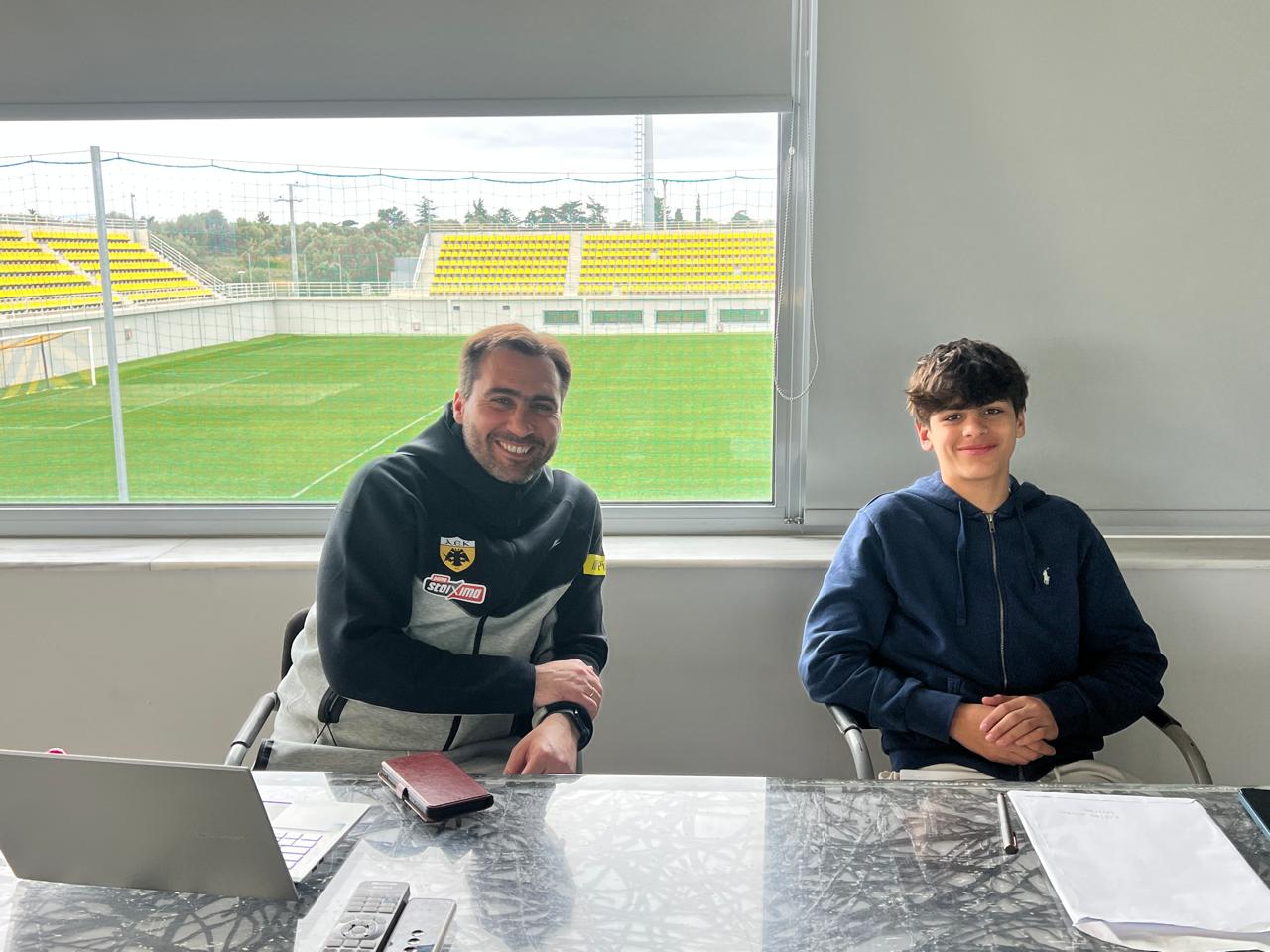
Interview with Ilias Kyriakidis, AEK Sport Development and Education Manager, Sport Director Development Network
Category: Interviews
Football and Athlete Development
What does an athlete need to perform well in a match or training session, and how does their environment affect them?An athlete must have good physical condition, technique, tactics, and psychology. Additionally, social and material-technical factors play a crucial role. Social factors (influence from family, friends, relationships with teammates, etc.) and material-technical factors (all kinds of equipment that facilitate the training process, such as proper balls, markers, cones, fitness equipment, etc.) are decisive in an athlete’s performance and overall development.
What are UEFA’s key policies regarding football?
The Union of European Football Associations (UEFA) has identified and set seven policies for the strategic period 2021-2030, which focus on goals and actions: 1) Combating racism, 2) Protecting children and youth, 3) Equality, 4) Inclusion in football, 5) Health, 6) Supporting refugees, 7) Solidarity and rights.
Why is football not just about the game?
Clubs must strategically function as centers for learning life skills, not just football skills. A football team should aim to develop the entire personality of the athlete. Whether referring to a pedagogical or a coaching-football approach, positive influences and creative stimuli should be provided, targeting the development of football skills while fostering the emotional, psychological, and intellectual aspects of each athlete’s personality.
How does football protect athletes from racial discrimination?
According to the UEFA Human Rights Commitment (2021), efforts are made to cultivate an inclusive culture where no one experiences discrimination or exclusion based on personal characteristics, whether they participate as an athlete, coach, referee, etc. Football, as a multifaceted sport, is also a large community that embraces every individual without discrimination, ensuring a safe environment. The relationship between sports, a healthy lifestyle, physical improvement, and mental well-being must be emphasized. In this context, according to the most translated contemporary Greek author, Nikos Kazantzakis, team sports serve a great moral purpose. He notably stated that in sports, one does not merely train their body but, above all, their soul. Similarly, Nelson Mandela always advocated that sport has the power to change lives and inspire people in extraordinary ways.
What does the European Union propose regarding athletes’ mental health?
The REPORT of the European Parliament’s Committee on Culture and Education regarding the EU’s sports policy emphasizes that sports authorities must consider athletes’ mental health protection just as they do their physical health.
Why are psychological skills as important as athletic skills?
If an athlete has a strong body but cannot manage stress or pressure, they may face issues in the future. Football clubs must recognize these educational aspects as follows:
- In training and matches, continuous management of psychological factors is necessary, as some athletes may not fully understand how these factors affect their behavior and performance.
- Psychological skills should be developed alongside physical skills; otherwise, an “imbalance” is created, which can be a source of “problems” at higher competitive levels, as the athlete might struggle to emotionally handle what they can physically execute.
- Through psychological preparation programs, an athlete can improve their mental profile.
- In training and matches, continuous psychological factor management should be applied, as some athletes may not fully understand how these factors impact their behavior and performance.
- A sports psychologist not only enhances a footballer’s performance but also helps them as an individual.
What does an athlete learn from their defeats?
Winning at all costs or winning by any means is not compatible with the goals of sports psychology. This perspective aligns with that of the great Greek writer Nikos Kazantzakis in his book Travelling England, where he states:
“You should not be ashamed of being defeated…English decalogue” (Kazantzakis, 2013).